
The complete guide
How to Clean Your Gutters From the Ground, Without a Ladder
The problem with gutters
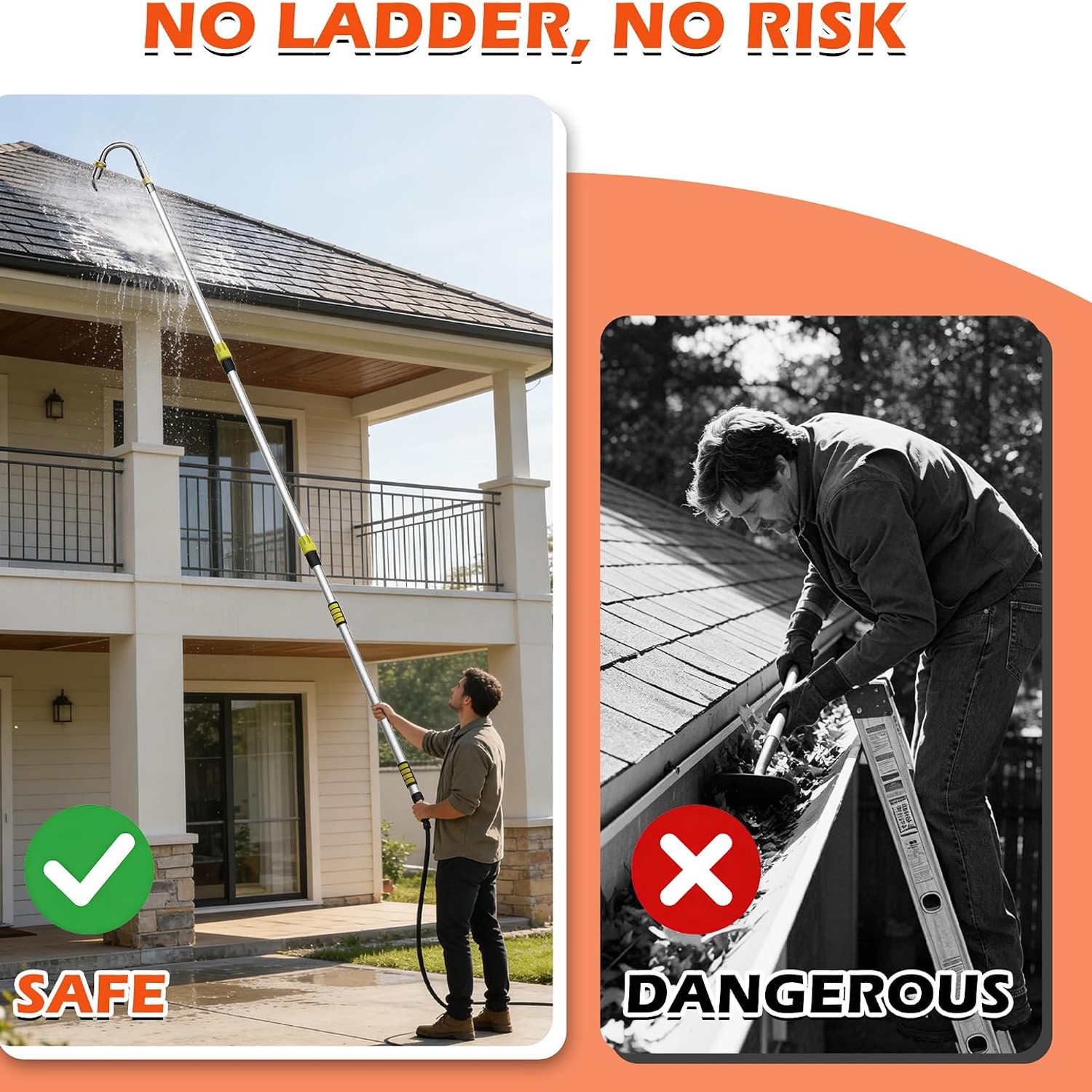
Nobody enjoys gutter cleaning. The job itself is not hard. What makes it unpleasant is the access. You drag a ladder out of the shed, find a bit of ground flat enough to trust, climb up with a bucket hooked over one arm, scoop a meter of wet sludge, then climb down and move the whole setup two meters along. On a modest house that is twenty or thirty ladder repositions. On a two-story, it is a job most people quietly put off.
The putting off is the expensive part. A gutter full of rotted leaves holds water like a planter box. That water finds the back of the fascia, soaks the timber, and starts the slow rot that eventually costs real money. In heavy rain the blockage sends a sheet of water straight down the wall instead of into the downspout, which means damp render, stained brickwork, and saturated soil right where you least want it, against the footings. Add the fire risk of dry leaf litter sitting in a metal channel on a hot day and the case for keeping gutters clear is not really arguable.
So the question is not whether to do it. It is how to do it without spending an afternoon on a ladder.
How a water-fed gutter tool works
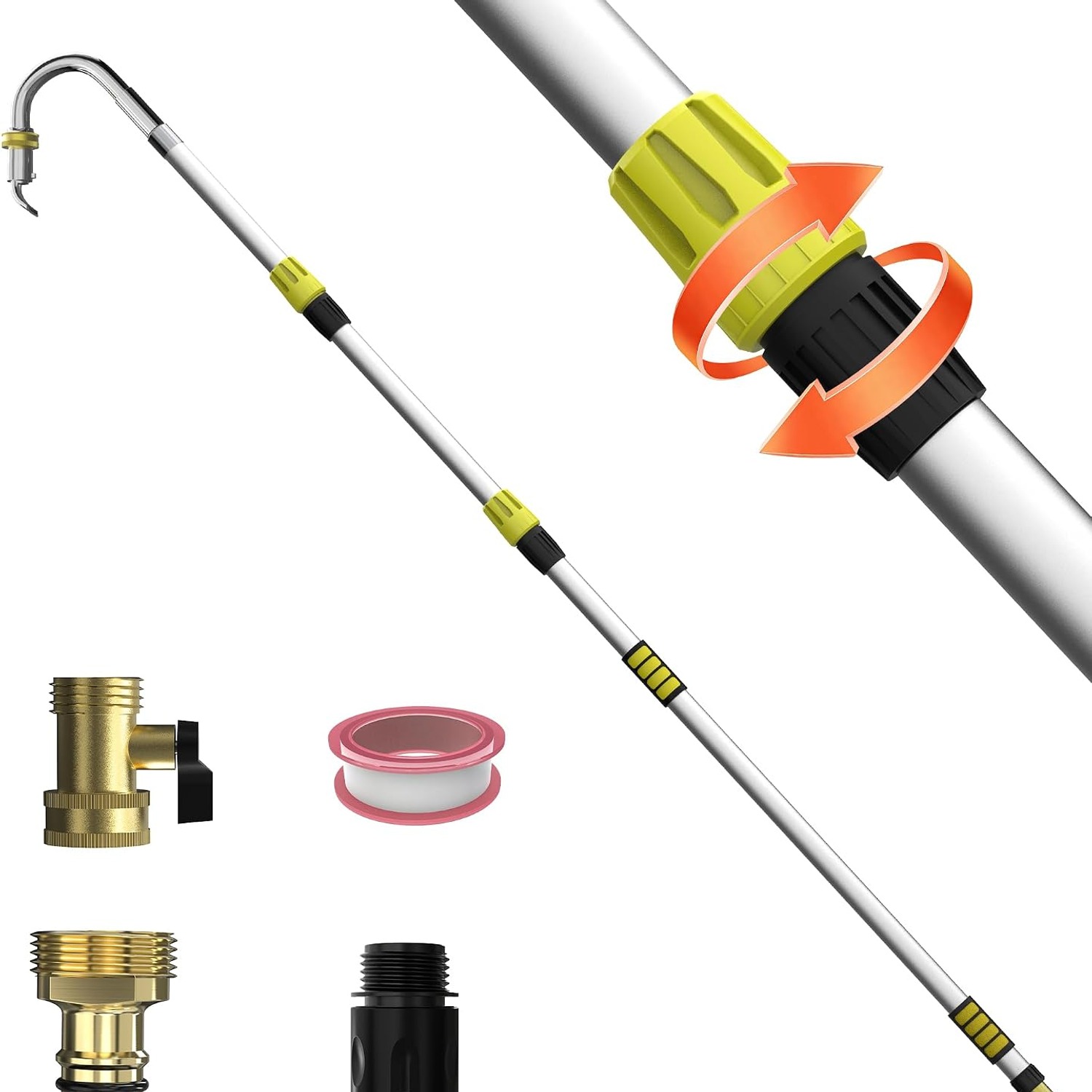
A gutter cleaning tool from the ground is a simple idea done properly. You take a long pole, run water up it from a garden hose, and put a shaped nozzle on the end that does two jobs at once.
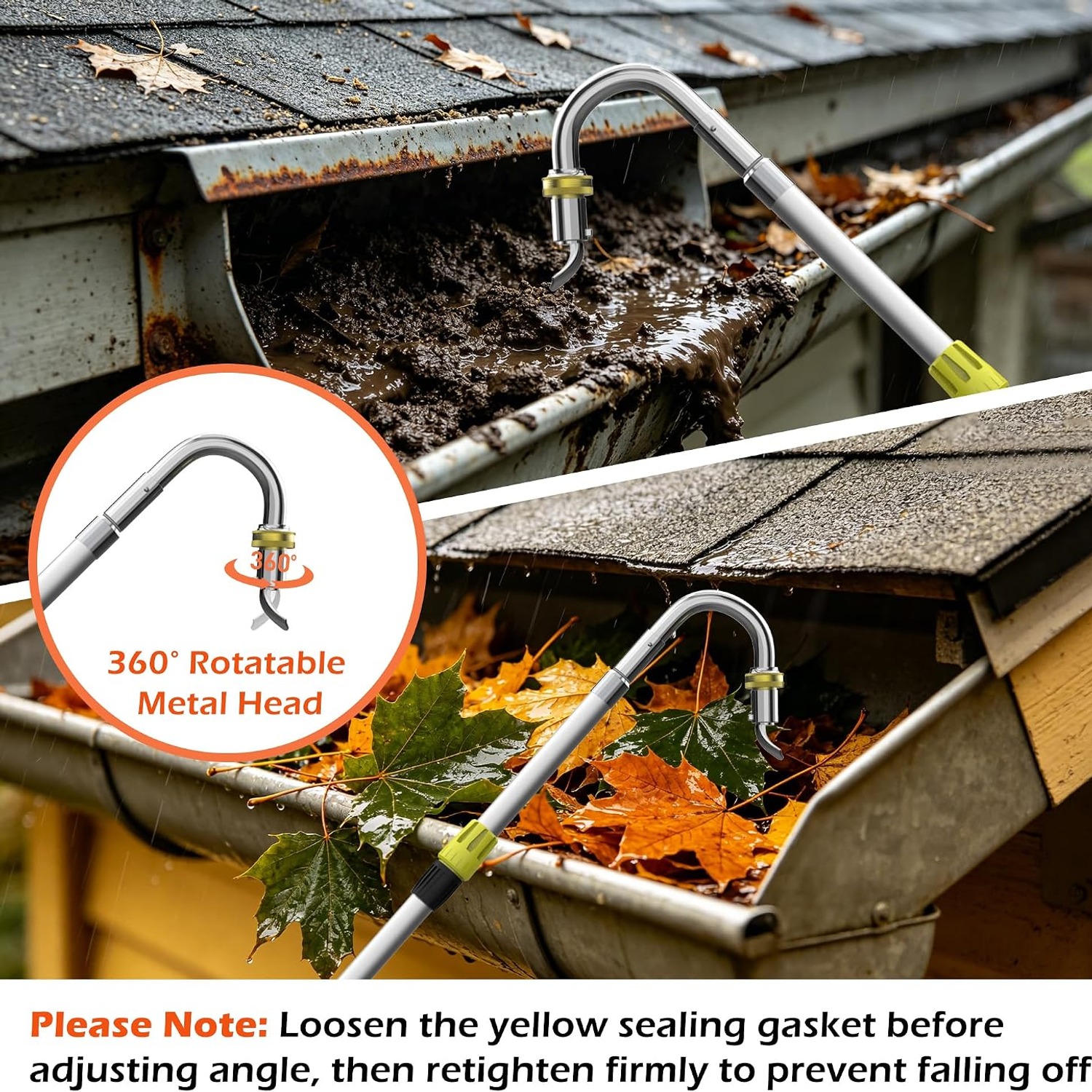
The first job is mechanical. The duckbill nozzle on this kit has a flat, angled metal tip. Push it into a mat of packed leaves and the edge breaks the mat apart. A round jet just bounces off dried silt, which is why cheap round-nozzle gutter wands disappoint people. A rigid metal duckbill does not flex away from the work.
The second job is hydraulic. That same flat shape fans the water into a wide blade instead of a pencil stream. Once the debris is loosened, the blade of water sweeps it along the channel toward the outlet. You are effectively sluicing the gutter, not picking it clean.
The head on this one rotates a full 360 degrees. That matters more than it sounds. Once you have a 16 ft pole balanced overhead, the last thing you want is to shuffle sideways and re-aim the whole assembly. Instead you roll the head. Point the stream along the run, then roll it to dig into a mitred corner, then roll it again to fire straight down the downspout. Your feet stay put.
The shut-off valve sits down at the hose end where you can reach it. Flick it off when you lift the pole out, flick it on when the nozzle is back in the gutter. Without one, every repositioning means a shower of dirty water down your sleeve, or a walk back to the tap.
Reach, and being honest about it
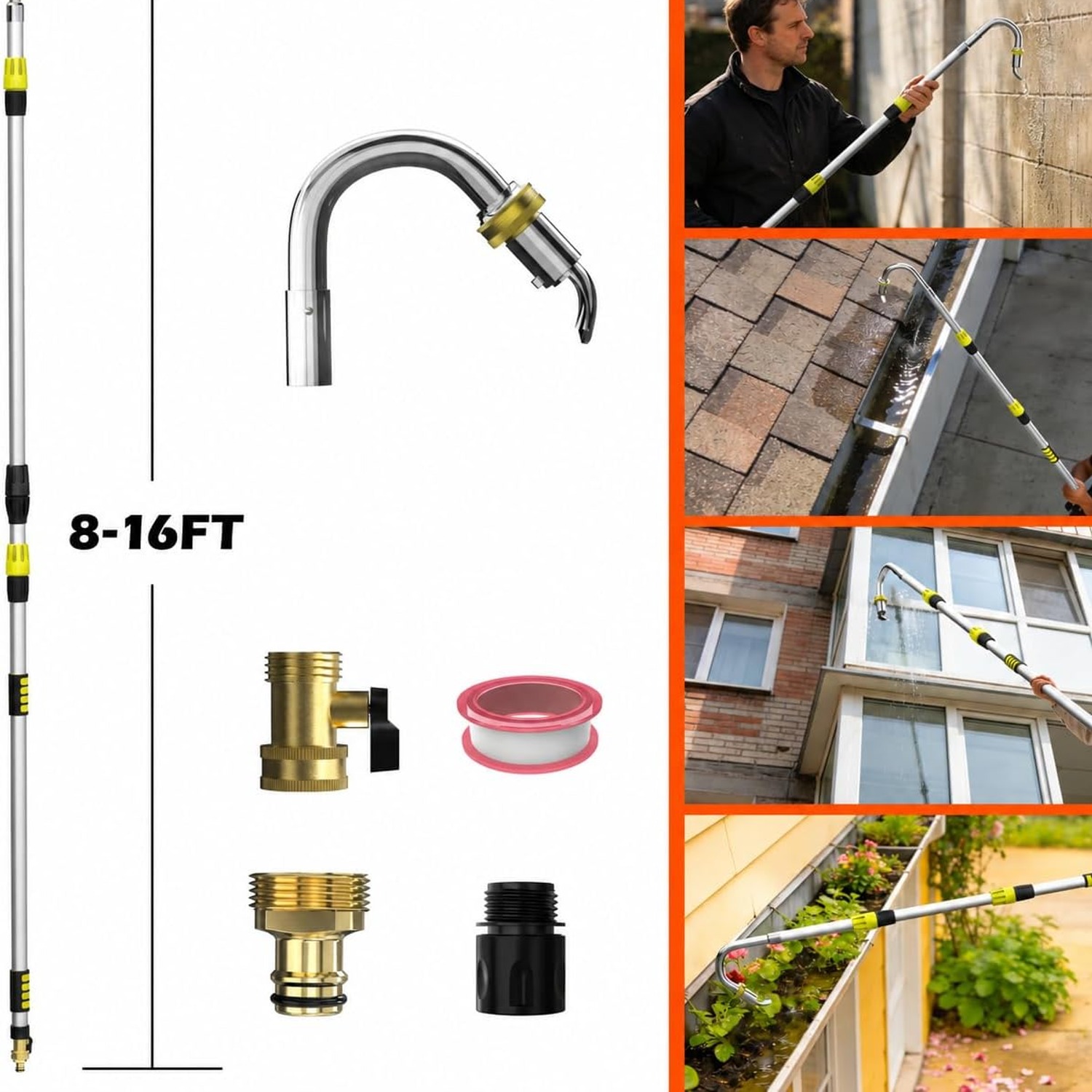
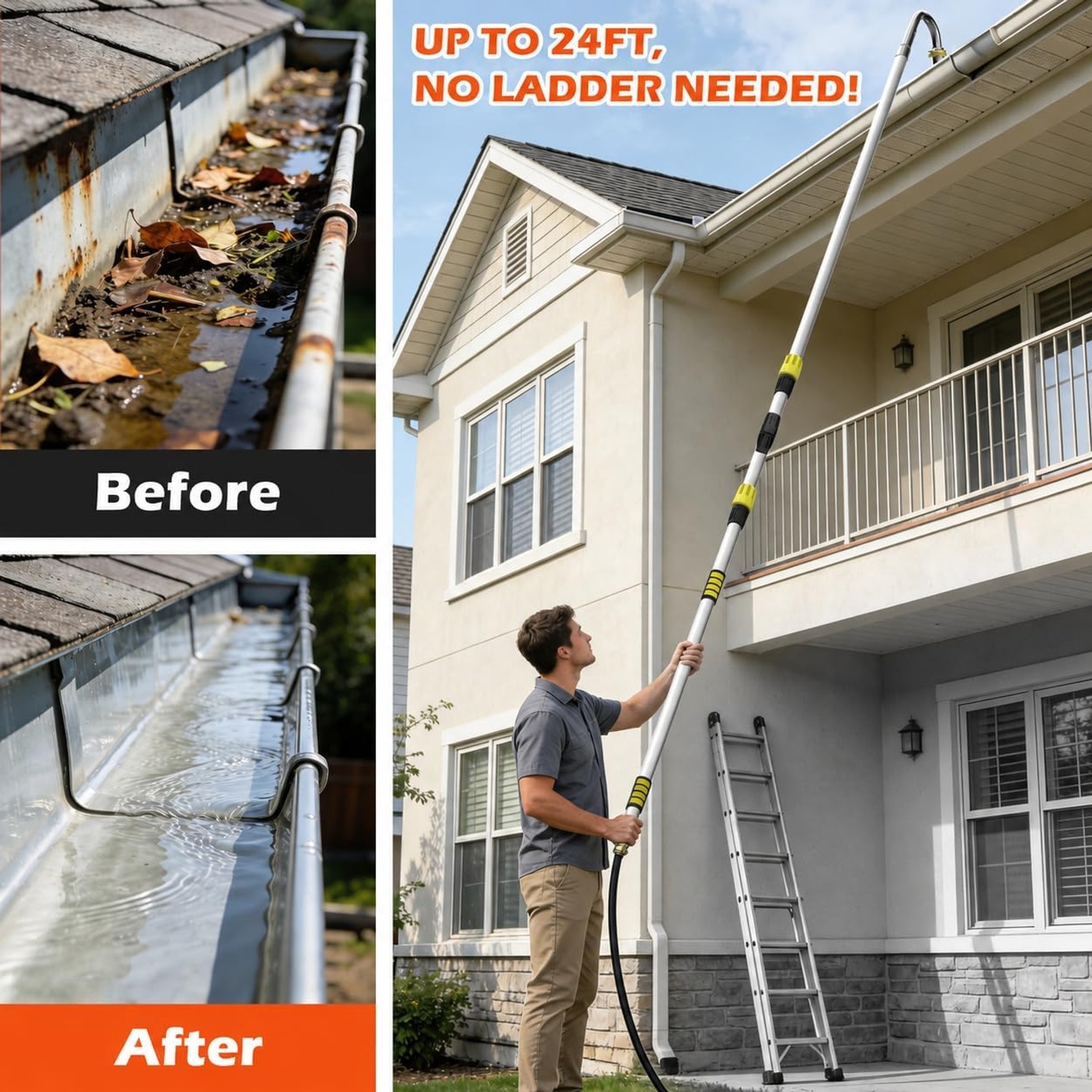
The pole is two aluminum sections. Collapsed it sits around 8 ft, extended it runs to 16 ft, and it locks anywhere in between with a twist. The stated working reach is up to 24 ft, which accounts for the pole plus the height of an average adult holding it at an angle.
Be realistic about your own house before you order. Measure from the ground to the top of the gutter. A typical single-story eave sits somewhere around 10 to 12 ft, which this handles easily and without full extension. A standard two-story eave tends to land in the 18 to 22 ft range, which is where the full 16 ft of pole earns its keep. If your eave is higher than 24 ft, or the house sits on a slope where you cannot stand directly below, this is not the right tool and you need proper access equipment.
Aluminum was the right call for the pole. Steel would be stiffer but heavier, and weight is the limiting factor when you are holding something overhead with water running through it. Expect to work in stretches of a few minutes rather than one continuous hour, and use two hands with the pole braced against your hip or forearm.
Who this suits
It suits homeowners with trees. If you have gums, pines, plane trees or anything else that drops constantly, you are doing this job two to four times a year, and that frequency is what makes owning a telescopic gutter cleaning pole cheaper than calling someone.
It suits anyone who should not be climbing. Plenty of people hit a point where a ladder on uneven ground is simply not a sensible risk. A no ladder gutter cleaner changes the job from a hazard into a chore.
It also suits people doing maintenance between proper clean-outs. A quick flush in early autumn, before the heavy drop, keeps the downspouts flowing and stops the mat from forming in the first place.
It is less suited to very high buildings, to gutters packed solid with years of compacted soil (those sometimes need hand clearing first), and to anyone on tank water with low pressure. The tool relies on mains pressure to move material.
Setting it up and using it well
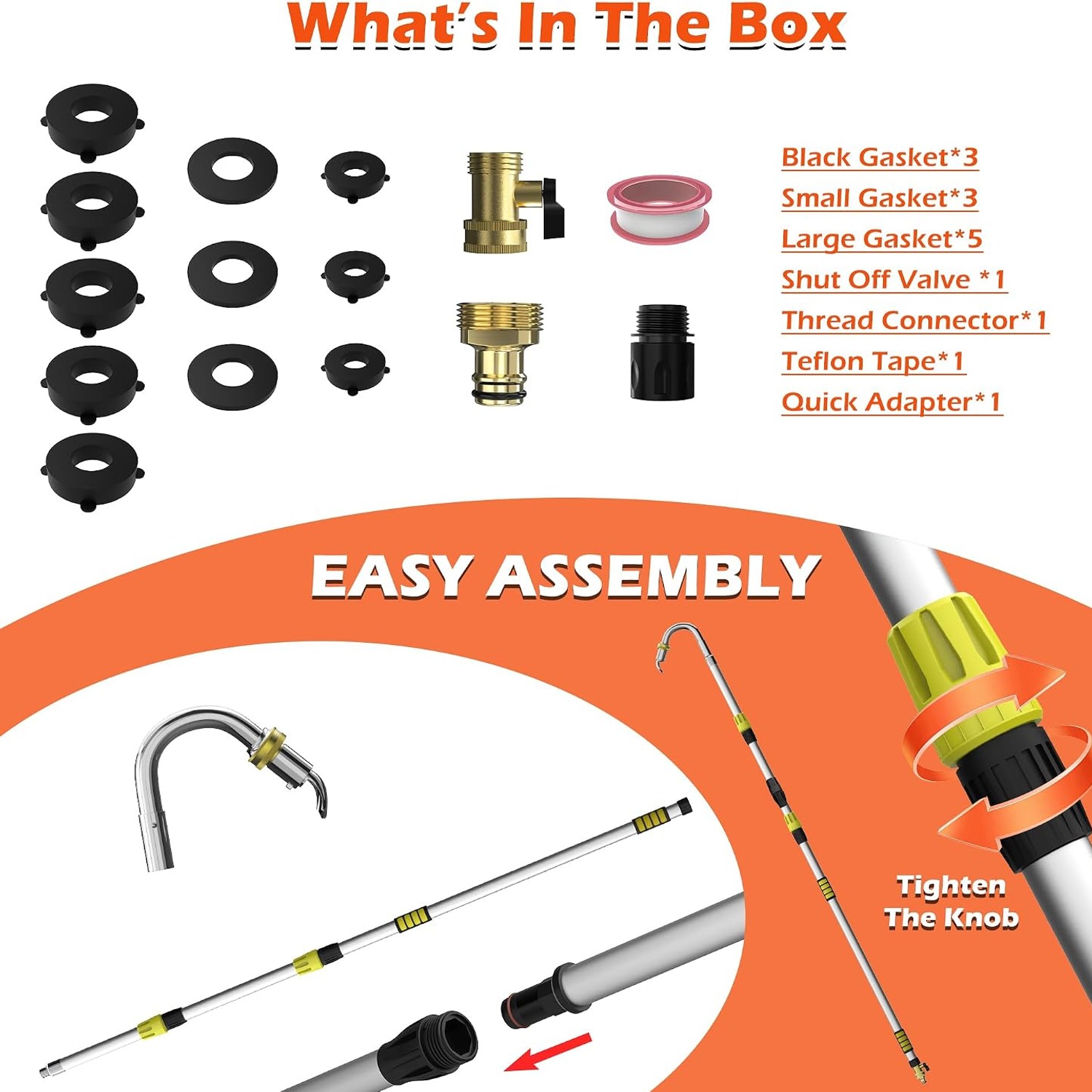
Assembly takes a few minutes. Wrap the threads in the supplied Teflon tape, seat the gaskets, and screw the valve, adapter, pole and nozzle together hand tight. Do not reach for a wrench. Over-tightening crushes gaskets and causes the leaks you were trying to prevent. Turn the water on slowly the first time and watch each joint.
Once you are running, a few habits make a big difference.
Work from the far end of the gutter toward the downspout, so everything you loosen travels in the right direction. If you work the other way you just push debris into a dead end.
Start with the water on and the nozzle slightly above the debris, letting the stream soften things before you start scraping. Dry, baked-on silt breaks up far more easily after thirty seconds of soaking.
Clear the downspout outlet early. If the outlet is choked, everything you flush simply pools and overflows on your head.
Put a tarp over garden beds and move the outdoor furniture. All that material has to land somewhere, and raking it off a tarp is much faster than picking it out of mulch.
And keep well away from overhead power lines. An extended aluminum pole with water running through it is a conductor. If cables run near your eaves, stop and call a professional.
Looking after it
The maintenance is trivial but worth doing. After each session, run clean water through to flush grit out of the nozzle, then collapse the pole and let the sections drain. Wipe the aluminum dry so it does not spot.
Store it with the twist locks backed off slightly. Locks left clamped tight for six months tend to seize, and freeing them later is annoying. Keep it hanging or lying flat in a dry shed rather than standing in a corner collecting moisture at the base.
If a joint starts weeping, do not tighten harder. Unscrew it, check the gasket, re-tape the thread and hand tighten again. The gaskets and tape are consumables and both are cheap to replace.
In cold climates, drain everything completely before storing for winter. Water trapped in a fitting that then freezes will split it.
The short version
Gutter cleaning is a job that gets dangerous mostly because of the ladder, not the gutters. This kit removes the ladder. You get a two-section aluminum pole that runs from 8 ft to 16 ft for up to 24 ft of reach, a rigid metal duckbill nozzle that scrapes as it flushes, a head that rotates 360 degrees so you can aim into corners and downspouts without moving, and a shut-off valve so you control the water from where you are standing. It threads onto a standard garden hose and ships with the adapter, gaskets and Teflon tape you need to put it together.
Measure your eave height first. If it sits comfortably under 24 ft, this turns a half-day ladder job into something you can knock over on a Saturday morning in a pair of old shoes.